
From Paralysis to the Cockpit: One Student's Fight Against Guillain-Barré Syndrome
When a simple cold turned into complete paralysis, a 17-year-old anonymous girl's dreams of becoming a pilot seemed to crash before they ever took flight. This is the story of how she found her way back.
A Cold That Changed Everything
It started like any other monsoon illness - a runny nose, a nagging cough, the kind of thing you shake off with hot soup and a few early nights. The young girl was in the thick of her 12th standard preparations, her desk stacked with physics textbooks and aviation magazines. The entrance exams were months away, and she had a plan.
But her body had other ideas.
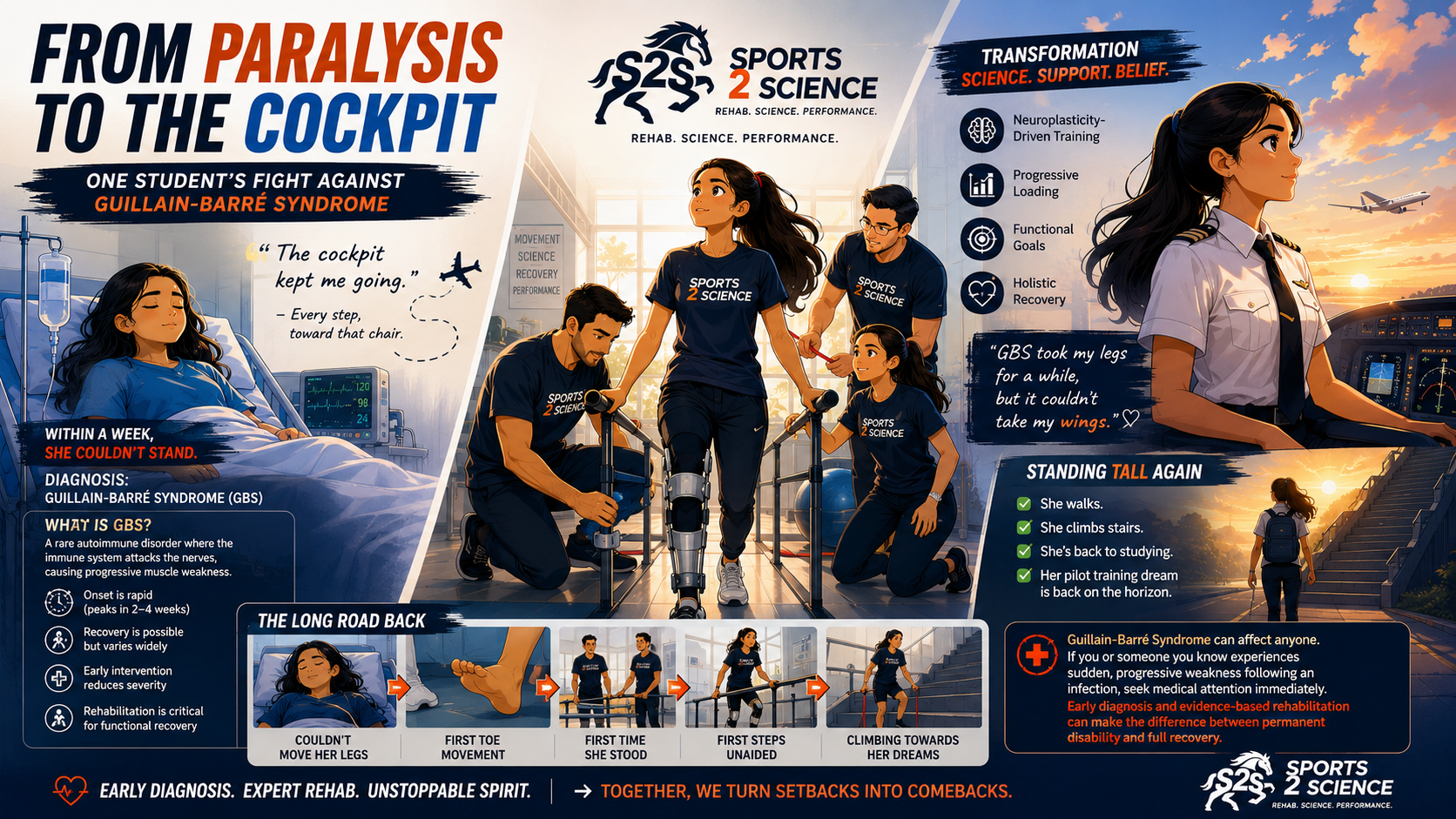
Within a week of that innocuous cold, something terrifying began to unfold. First came the tingling in her feet - a strange numbness she dismissed as sitting too long at her desk. Then her legs grew heavy, uncooperative. By the time her parents rushed her to the hospital, she couldn't stand.
The diagnosis came after a lumbar puncture confirmed what the neurologists suspected: Guillain-Barré Syndrome (GBS) - a rare condition where the immune system, fresh from fighting off an infection, turns on the body's own nerves.
What Is Guillain-Barré Syndrome?
Guillain-Barré Syndrome is a neurological disorder that affects roughly 1–2 people per 100,000 each year. It typically follows a viral or bacterial infection - a respiratory illness, gastroenteritis, or sometimes even a routine vaccination response gone awry.
Here's what happens: the immune system, confused after battling an infection, begins attacking the myelin sheath - the protective coating around peripheral nerves. The result is progressive muscle weakness that often starts in the legs and can ascend upward, sometimes affecting breathing, swallowing, and facial muscles.
Key Facts About GBS
- Onset is rapid - weakness typically peaks within 2–4 weeks
- Recovery is possible but varies widely - some patients recover fully in months, others face years of rehabilitation
- Early intervention matters - treatments like plasmapheresis and intravenous immunoglobulin can reduce severity
- Rehabilitation is critical - physical therapy determines how much function returns and how quickly
For the young girl lying in that hospital bed unable to move her legs, the statistics felt meaningless. All she knew was that her board exams were approaching, her future was uncertain, and her body had become a stranger.
The Weight of Stillness
The hardest part wasn't the paralysis itself - it was watching life continue without her.
Her classmates sat for their 12th standard exams. Her study group moved on to entrance prep. The aviation dreams she'd nurtured since childhood felt impossibly distant. How could she fly a plane when she couldn't even walk to the bathroom?
Depression crept in alongside the physical symptoms. Her parents watched helplessly as their daughter - once so driven, so certain of her path - retreated into silence.
"I remember thinking my life was over at 17," she would later recall. “Not literally, but everything I'd worked toward, everything I wanted to be - it felt like it had been taken from me overnight.”
A Scientific Approach to Recovery
The turning point came when her family connected with Sports2Science, a rehabilitation team that specializes in evidence-based recovery protocols. Their approach wasn't about quick fixes or motivational platitudes - it was grounded in neuroscience, biomechanics, and the remarkable plasticity of the human nervous system.
The rehabilitation philosophy was built on several principles:
1. Neuroplasticity-Driven Training
The brain and nervous system can rewire themselves - but only with the right stimulus. Her program focused on repetitive, task-specific movements that encouraged her damaged nerves to form new connections.
2. Progressive Loading
Starting with passive movements, then assisted exercises, then active resistance - each phase was calibrated to her nervous system's capacity at that moment, pushing just enough to stimulate adaptation without causing setbacks.
3. Functional Goals
Rather than abstract metrics, therapy centered on movements that mattered to her: standing at her desk, walking to the kitchen, eventually climbing stairs. Each milestone was a brick in the foundation of her confidence.
4. Holistic Recovery
Physical therapy alone wasn't enough. The team addressed sleep, nutrition, mental health, and the psychological trauma of sudden disability. Recovery, they understood, happens in the mind as much as the muscles.
The Long Road Back
Progress was measured in millimeters and seconds.
The first time she wiggled her toes intentionally, her mother cried. The first time she stood - shaky, supported, but standing - felt like summiting a mountain. The first unassisted steps came months later, each one a small rebellion against the diagnosis that had tried to ground her.
There were setbacks. Days when fatigue won. Moments of doubt that felt bottomless. But the Sports2Science team had prepared her for this - recovery from GBS isn't linear. It's a series of plateaus and breakthroughs, frustrations and small victories.
What kept her going?
"The cockpit," she says simply. “I kept picturing myself in the captain's seat. Every exercise, every painful step - I was walking toward that chair.”
Standing Tall Again
Today, she walks. She climbs stairs. She's resumed her studies, this time with a clarity and determination that wasn't there before.
The board exams she missed? She'll take them. The pilot training she dreamed of? It's back on the horizon - not as a fantasy, but as a plan.
Her family, who spent months navigating fear and uncertainty, has found solid ground again. "We got our daughter back," her father says. “But in some ways, she came back stronger than before.”
What This Story Teaches Us
GBS is terrifying because it strikes without warning and takes so much so quickly. But this journey illustrates several important truths:
- Early, expert rehabilitation changes outcomes. The nervous system responds to structured, science-based intervention. Passive waiting isn't recovery.
- Mental resilience is trainable. Just as muscles can be strengthened, so can the psychological capacity to endure hardship.
- Goals matter. Having something to move toward - a dream, a purpose - provides fuel when the body wants to quit.
Recovery takes a village. Family support, expert guidance, and a patient's own determination form a triangle that holds everything together.
A Message from the Runway
She isn't a pilot yet. She has exams to pass, training to complete, certifications to earn. The path is long.
But she's walking it - literally and figuratively. The girl who couldn't move her legs is now preparing to soar.
"GBS took my legs for a while," she says. "But it couldn't take my wings."
Guillain-Barré Syndrome can affect anyone. If you or someone you know experiences sudden, progressive weakness following an infection, seek medical attention immediately. Early diagnosis and evidence-based rehabilitation can make the difference between permanent disability and full recovery.
How Sports2Science Can Help
Recovery from neurological conditions like Guillain-Barré Syndrome requires more than just rest - it requires structured rehabilitation, movement science, and long-term guidance. At Sports2Science, our team focuses on evidence-based rehabilitation approaches designed to improve movement, strength, balance, confidence, and overall quality of life.
From neurological rehabilitation and movement retraining to strength recovery, gait analysis, posture correction, and performance restoration, our goal is to help individuals regain independence and return to the activities they love. Every recovery journey is different, and our programs are tailored scientifically based on the individual’s condition, functional limitations, and goals.
If you or your loved one is struggling with movement difficulties, weakness, post-injury recovery, or neurological rehabilitation, connect with Sports2Science Contact for professional support and guidance.
Movement. Recovery. Confidence. Science-Driven Rehabilitation.