

After the Pain: One Badminton Athlete's Journey from Shattered Confidence to Stronger Comeback
By Sports2Science
The court used to feel like home. The squeak of shoes on polished wood, the sharp crack of a shuttlecock leaving the racket, the rhythm of rallies that felt as natural as breathing. Then came the pain—a dull ache along the inside of my shin that I ignored for weeks, then months, until I couldn't ignore it anymore.
Medial Tibial Stress Syndrome. Four words that changed everything.
When Your Body Betrays You
It started small. A tightness after training. A twinge during footwork drills. I told myself it was normal—just the price of pushing hard, of chasing podiums, of wanting it badly enough.
But MTSS doesn't care about your ambition.
The diagnosis came after I could barely walk off the court following a district semifinal. The doctor's words blurred together: inflammation... bone stress... rest... possibly months. I nodded, but I wasn't really listening. All I could think was: What am I without badminton?
The Spiral
The physical pain was manageable. What nobody prepares you for is the psychological freefall.
The first week, I convinced myself I'd be back in two. The second week, I watched my teammates train through the window of the physiotherapy room. By the third week, I stopped going to the facility altogether.
I didn't recognize myself. I'd built my entire identity around being an athlete—around early mornings, tournament schedules, the satisfying exhaustion of a hard session. Without that, I felt hollow.
The thoughts came slowly at first, then all at once:
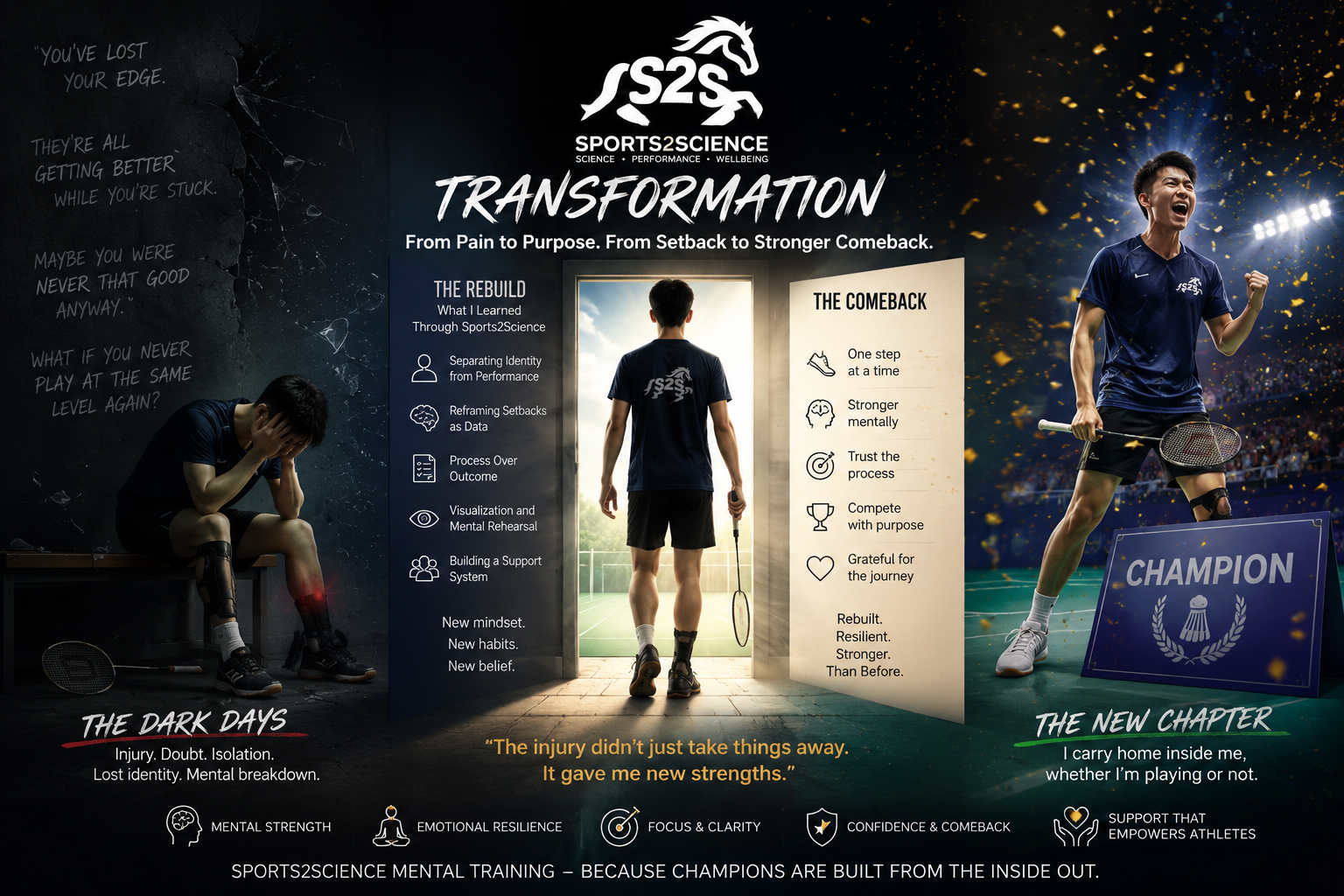
• You've lost your edge.
• They're all getting better while you're stuck.
• Maybe you were never that good anyway.
• What if you never play at the same level again?
I withdrew from friends. I stopped answering calls from my coach. I scrolled through social media watching other athletes compete and felt a toxic mix of envy and despair. Sleep became difficult. Motivation for rehab exercises—the only thing that could actually help me—evaporated.
I was physically injured, but mentally, I was completely broken.
Finding Sports2Science
My mother found the Sports2Science program. I dismissed it at first—I didn't need a psychologist, I needed my shin to heal. But she signed me up anyway, and I showed up to that first session with my arms crossed and my defenses high.
The psychologist didn't try to fix me. She just listened.
And then she asked a question that cracked something open: "Who were you before badminton? And who do you want to become because of it?"
I didn't have an answer. That was the problem—and the starting point.
The Rebuilding: What I Learned Through Sports2Science
Separating Identity from Performance
The first major shift was understanding that I am not my sport. Badminton is something I do, and I do it with passion and commitment—but it doesn't define my worth as a human being. An injury doesn't make me "less than." A loss doesn't erase my value.
This sounds obvious written down. Living it is much harder. We did exercises where I wrote down my values, my relationships, the parts of myself that had nothing to do with a racket. Slowly, I started to see a fuller picture.
Reframing Setbacks as Data
My psychologist introduced me to the concept of cognitive reframing. Instead of viewing the injury as a catastrophe or punishment, I learned to see it as information.
My body was telling me something. My training load had been unsustainable. My recovery habits were poor. My technique had inefficiencies that were creating repetitive stress. The injury wasn't a wall—it was a signal pointing toward what needed to change.
Process Over Outcome
I'd always been outcome-obsessed: rankings, medals, match results. Sports2Science helped me shift toward process goals—small, controllable actions that I could execute daily regardless of results.
During recovery, my process goals looked like this:
• Complete today's physio exercises with full focus
• Practice five minutes of visualization
• Write one thing I'm grateful for related to my sport
None of these required a healthy shin. All of them kept me connected to my identity as an athlete while my body healed.
Visualization and Mental Rehearsal
When I couldn't physically play, I played in my mind. Detailed visualization—feeling the grip of the racket, hearing the sound of the shuttle, seeing my footwork patterns—kept my neural pathways engaged. Studies suggest this kind of mental rehearsal can help maintain motor skills and confidence during injury layoffs.
At first, I felt silly lying on my bed with my eyes closed, imagining rallies. But over time, it became one of my most powerful tools.
Building a Support System (and Letting Them In)
I'd isolated myself because I felt like a burden. Sports2Science helped me understand that vulnerability isn't weakness—it's the foundation of genuine connection. I started talking honestly with my coach, my teammates, my family. Their support didn't fix me, but it reminded me I wasn't alone.
The Comeback
Returning to the court wasn't a single moment—it was hundreds of small ones.
The first day I could jog without pain. The first shadow footwork session. The first tentative rally with a teammate who fed me easy shots. Each step felt fragile, like I might shatter again at any moment.
But I had new tools now.
When anxiety crept in before my first competitive match back, I used the breathing techniques I'd practiced. When I lost that match—badly—I didn't spiral. I debriefed with my psychologist, identified what I could learn, and showed up to training the next day.
Six months after that first loss, I won my first tournament back. Not a major one. A local event that wouldn't have mattered to me before the injury. But standing on that podium, I cried—not because of the medal, but because of what it represented.
I had rebuilt myself. Not just my shin, but my mind.
What I Want Other Athletes to Know
If you're reading this from the other side of an injury—physical or mental—I want you to hear this:
The darkness is lying to you. The voice that says you're finished, that you'll never be the same, that everyone else is moving on without you—it's fear talking. Fear is loud, but it's not truth.
Asking for help is an athletic skill. We train our bodies relentlessly. Training our minds deserves the same commitment. Sports psychology isn't a sign that something is wrong with you. It's a sign that you're serious about performing at your best.
You will come back different—and that can be better. I'm not the same player I was before MTSS. I'm smarter about recovery. I'm more connected to my body's signals. I'm mentally tougher because I've survived something I thought would break me. The injury didn't just take things away. It gave me new strengths.
Looking Forward
Today, I train with intention. I rest without guilt. I compete with a fire that's different from before—less desperate, more grounded. I still have hard days. The fear of re-injury whispers sometimes, especially during intense footwork sessions. But I know how to meet that fear now. I have strategies. I have support. I have proof that I can come back from the bottom.
Medial Tibial Stress Syndrome tried to end my career. Instead, it became the chapter where I learned who I really am.
The court still feels like home. But now I know—I carry home inside me, whether I'm playing or not.
Sports2Science Mental Training for Athletes
At Sports2Science, mental performance is treated with the same importance as physical performance. Many athletes silently struggle with fear, anxiety, loss of confidence, burnout, pressure, emotional breakdown after injuries, performance inconsistency, and identity crises during setbacks. Through structured sports psychology sessions, visualization training, breathing techniques, mindset coaching, emotional resilience training, and athlete-centered rehabilitation support, Sports2Science helps athletes rebuild not only their performance—but also their confidence, clarity, and purpose.
Whether you are recovering from injury, preparing for competition, struggling with confidence, or trying to return stronger after setbacks, Sports2Science aims to support athletes scientifically, emotionally, and mentally through every phase of sport and life.
Keywords: sports psychology Chennai, badminton mental training, athlete mindset training, injury recovery support, mental conditioning for athletes, sports rehabilitation Chennai, Sports2Science mental performance.