
The Hidden Danger of Compensation in the Human Body
How Small Movement Changes Slowly Become Bigger Injuries
Have you ever looked at a ceiling fan and noticed how smoothly a new fan rotates? The movement feels balanced, controlled, and effortless. Usually, the fan has three blades sharing the load evenly while cutting through the air together. But imagine if one of those blades develops even a small bend. Suddenly, the fan no longer rotates the same way. It may begin to wobble, create vibrations, lose efficiency, produce unusual sounds, or sometimes even stop functioning properly over time.
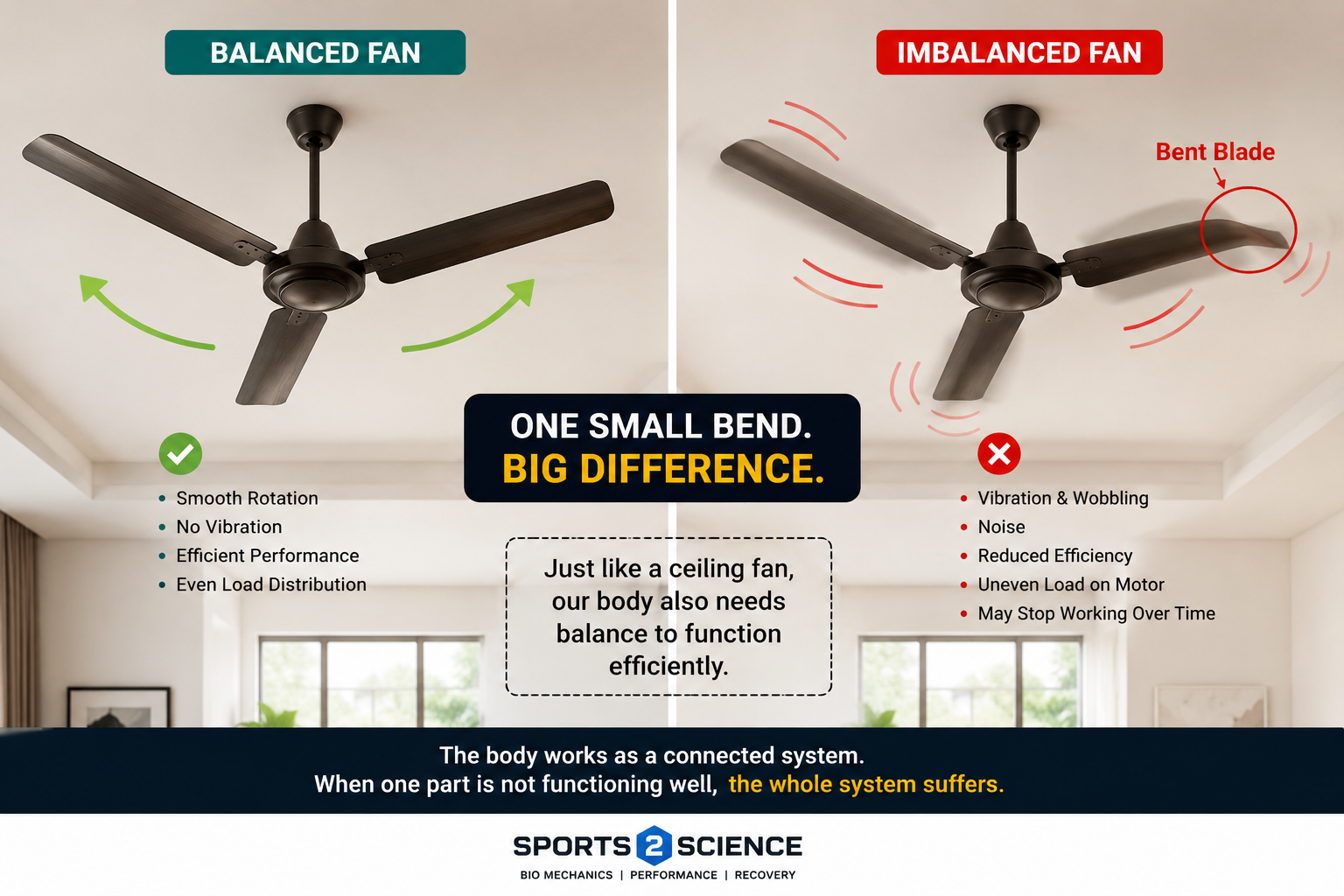
What is interesting is that the other blades may still be completely fine.
Yet the entire system suffers because one part is no longer doing its role properly.
The human body works in a very similar way.
At Sports2Science, compensation is one of the most important concepts we observe in biomechanics and movement science. The body is designed to function as a coordinated chain where muscles, joints, tendons, and nerves continuously work together to distribute load efficiently. Every movement — whether it is walking, running, sitting, lifting, jumping, or even standing — depends on multiple regions of the body communicating and sharing stress together.
When one area loses mobility, strength, control, or stability, the body rarely stops moving completely. Instead, it adapts.
That adaptation is called compensation.
Initially, compensation is actually intelligent. The body tries to protect itself by shifting load away from the weak or restricted area so movement can continue. This is why many people continue their daily activities even when something is not functioning optimally. However, the problem begins when compensation continues for weeks, months, or sometimes years without correcting the original issue.
Slowly, the body starts placing stress on structures that were never meant to handle that extra workload continuously.
Modern lifestyle itself quietly encourages these compensation patterns. Long hours of sitting, repetitive office posture, reduced physical activity, poor sleep, excessive screen time, and lack of mobility work gradually influence how the body moves. A person may sit for prolonged periods every day without realizing that the hip flexor muscles are slowly becoming tighter. As those muscles stiffen, the pelvis may begin tilting forward into an anterior pelvic tilt posture. Once this happens, the lower back often starts absorbing greater stress during standing, walking, or exercise.
At first, the body may only feel “tight.”
Then occasional discomfort appears.
Later, chronic back pain develops.
What makes compensation dangerous is that the pain often appears far away from the original problem. Someone may feel knee pain, but the actual limitation may exist at the hips or ankles. Another person may experience neck tightness, while the underlying issue may be poor thoracic mobility or weak postural muscles. The body continuously finds alternative ways to maintain movement, but these alternatives are often mechanically inefficient over time.
This is why movement should never be viewed as isolated body parts working independently. Human movement behaves like a chain. When one link changes, every other link around it also adjusts. A restricted ankle may alter walking mechanics. That altered walking pattern may overload the knee. The knee compensation may later affect hip stability, eventually influencing spinal loading and posture. By the time pain becomes severe, the body may have been compensating silently for months.
In sports and exercise science, these hidden movement changes are extremely important because performance and injury risk are both deeply connected to movement efficiency. Athletes often continue training through small stiffness, minor imbalance, or subtle asymmetry without noticing how the body is adapting underneath. Over time, repetitive compensation can reduce force transfer, increase tissue stress, decrease movement efficiency, and eventually create chronic injury patterns.
Interestingly, compensation itself is not the enemy. In many situations, compensation allows us to survive, continue functioning, and temporarily protect injured tissues. The real danger appears when the body remains stuck in compensation for too long without restoring proper movement quality, strength, mobility, or control.
This is one of the reasons why biomechanics assessment and movement analysis are becoming increasingly important. Pain is often the final stage of a problem rather than the beginning. Long before pain appears, the body usually gives warning signs through stiffness, reduced mobility, poor posture, balance changes, movement asymmetry, muscle tightness, or reduced coordination. Unfortunately, these signs are often ignored because they seem small at the time.
But small compensations rarely stay small forever.
Just like the ceiling fan with one bent blade, the body slowly loses efficiency, balance, and control when one area consistently fails to function properly. The earlier these movement compensations are identified, the better the body can recover, perform, and stay injury-free in the long term.
At Sports2Science, we believe understanding movement is one of the most powerful steps toward injury prevention and human performance. The body should not be viewed as separate muscles and joints working independently, but rather as one connected system where every movement influences another. Sometimes the painful area is not the true problem. Sometimes the body has simply been compensating for too long.
Because in human movement, even a small imbalance can eventually affect the entire system.