

How Long Screen Time and Stressful Sitting Jobs Are Quietly Changing Human Hormones
Modern life looks successful from the outside.
People wake up early, rush through traffic, sit in air-conditioned offices, attend meetings, stare at screens for hours, reply to endless notifications, return home exhausted, sleep late, and repeat the same cycle again the next morning. Society celebrates this lifestyle as productivity, ambition, and success. But very few people stop and ask an important question:
What is this lifestyle doing to the human body?
The truth is that human biology was never designed for continuous sitting, artificial lighting, chronic stress, poor sleep, and endless digital stimulation. The human body evolved through movement, sunlight exposure, social interaction, physical work, recovery, and natural sleep cycles. Yet modern work culture slowly removes almost all of these from daily life.
Most people notice only the obvious effects at first — neck pain, eye strain, headaches, fatigue, back pain, or stiffness. But deeper inside the body, another silent change is happening through the hormonal system. Hormones are not just chemicals. They are the body’s communication network. They regulate energy, sleep, metabolism, muscle health, mood, recovery, motivation, fertility, stress response, and even emotional stability. When lifestyle continuously disturbs this system, the body slowly begins to lose its natural balance.
For men, one of the biggest changes often occurs through testosterone regulation. Testosterone is strongly connected to movement, muscle activity, sleep quality, recovery, confidence, and metabolic health. Long hours of sitting reduce muscular activation and circulation, while stressful jobs increase cortisol levels. Over time, chronic stress and poor recovery may suppress testosterone production. Many men begin experiencing reduced energy, lower motivation, abdominal fat gain, poor recovery, mental fatigue, lower confidence, and decreased physical performance. Unfortunately, these symptoms are often ignored or normalized as “part of getting older,” when in reality the body may simply be adapting poorly to an unhealthy environment.
At the same time, the stress hormone cortisol continues to rise. Modern jobs constantly activate the nervous system through deadlines, multitasking, financial pressure, digital overload, and mental tension. The body does not clearly differentiate between physical danger and psychological stress. Continuous workplace pressure keeps the body in a prolonged survival state. While cortisol is important for short-term survival, chronic elevation can slowly become harmful. It may contribute to anxiety, irritability, sleep disturbances, elevated blood sugar, muscle breakdown, chronic fatigue, and increased fat accumulation around the abdomen.
Another major issue is how long sitting affects metabolism. Human muscles play an important role in glucose regulation. When movement reduces for long periods, the body becomes less efficient at using glucose properly. Even people who exercise for one hour daily may still experience metabolic problems if they remain sedentary for the remaining ten or twelve hours. Over time, this may contribute to insulin resistance, weight gain, reduced physical capacity, and increased risk of metabolic disorders.
The brain is also being affected in ways many people do not realize. Continuous notifications, social media scrolling, rapid task switching, short-form content, and digital overload overstimulate the brain’s reward pathways. Slowly, the brain becomes dependent on constant stimulation. Attention span reduces, focus becomes difficult, deep work feels exhausting, and mental fatigue appears despite very little physical activity. Many people today feel mentally drained not because they are physically overworking, but because their nervous system rarely gets true recovery.
For women, the hormonal impact can sometimes become even more sensitive because stress strongly influences reproductive and endocrine regulation. Long work hours, emotional stress, poor recovery, and sleep deprivation may influence the hypothalamic-pituitary-ovarian axis, contributing to irregular menstrual cycles, increased PMS symptoms, fatigue, mood fluctuations, and reduced recovery. The body naturally prioritizes survival during chronic stress, which means reproductive health may slowly become secondary.
Sedentary lifestyles may also influence estrogen balance and inflammation. Reduced movement combined with prolonged sitting can contribute to fatigue, weight gain, reduced physical capacity, and mood changes. Poor posture and restricted breathing mechanics from continuous sitting may further increase nervous system stress and physiological strain throughout the day.
Many women experiencing chronic stress also report brain fog, low energy, slower metabolism, and persistent tiredness despite sleeping. While sitting itself does not directly damage the thyroid, the combination of poor recovery, chronic stress, inactivity, and nutritional imbalance can influence endocrine regulation significantly.
Another growing concern is insulin resistance and its relationship with conditions such as PCOS. Modern sedentary lifestyles reduce metabolic efficiency and movement-based glucose regulation. The human body depends on movement not only for fitness, but for hormonal balance itself.
One of the most damaging aspects of modern life is how normalized unhealthy living has become. People proudly sacrifice sleep for work, skip movement for productivity, eat while staring at screens, avoid sunlight for entire days, and ignore recovery for years. Then eventually the body begins asking for help through fatigue, pain, hormonal imbalance, emotional exhaustion, poor sleep, reduced performance, and chronic health issues.
The body whispers before it screams.
What makes this even more tragic is that many people spend their younger years sacrificing health to earn money, only to spend their later years using that money to recover lost health. Slowly, the body loses its ability to function naturally. Energy no longer comes naturally, so stimulants and supplements become daily requirements. Sleep no longer happens naturally, so medications are needed. Blood sugar rises, blood pressure increases, stress tolerance reduces, posture deteriorates, and chronic pain becomes part of normal life.
Technology evolved rapidly, but human biology did not.
The human body still needs movement, sunlight, breathing space, muscular activity, social connection, recovery, and sleep. Without these, even highly successful lifestyles may become biologically expensive over time.
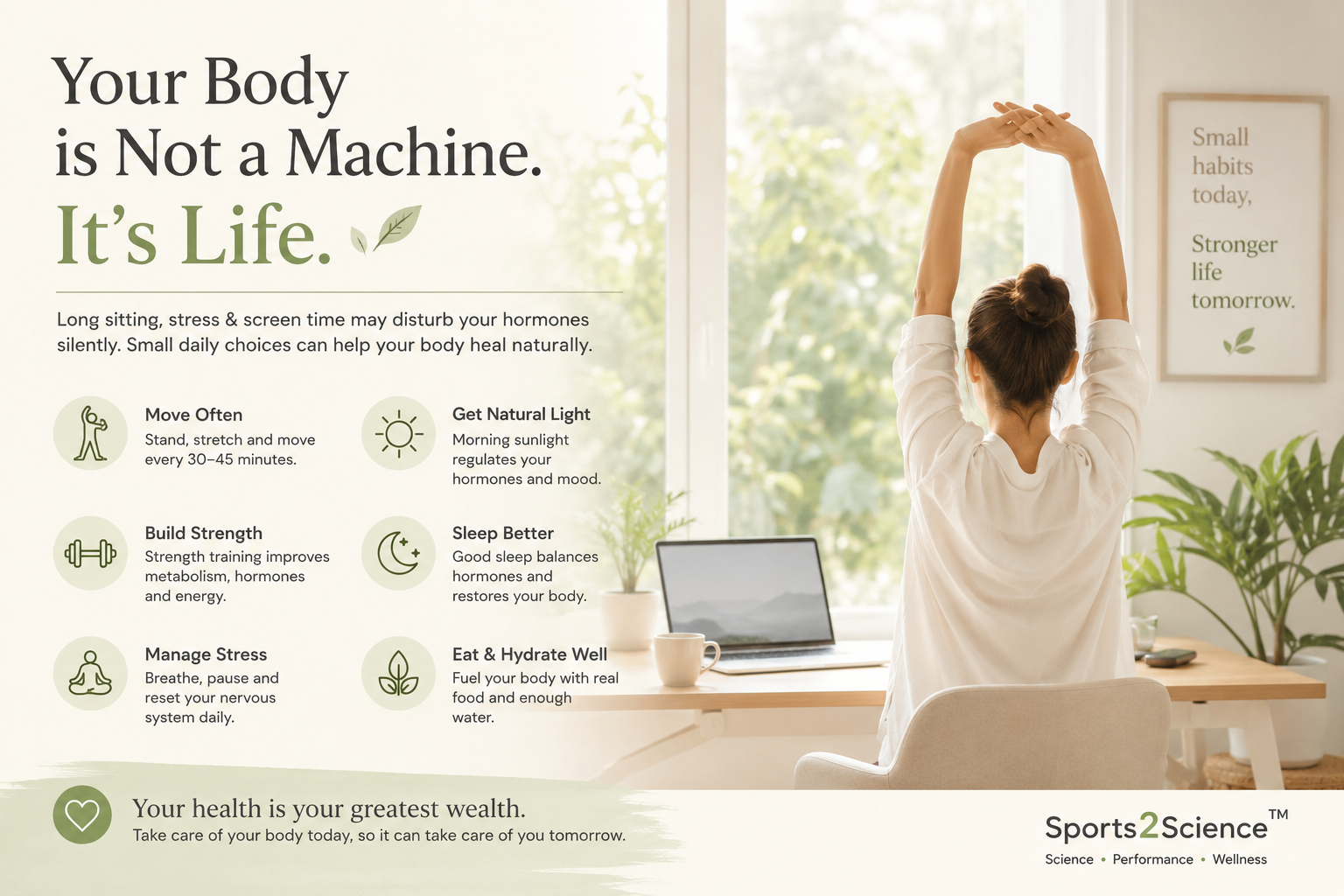
The good news is that the body also has an incredible ability to adapt positively when given the right environment. Small consistent changes can create powerful physiological improvements. Standing and moving every thirty to forty-five minutes helps circulation and muscular activation. Strength training improves metabolic health, insulin sensitivity, musculoskeletal function, and hormonal support. Morning sunlight helps regulate circadian rhythm and sleep quality naturally. Reducing screen exposure before bedtime supports melatonin production and nervous system recovery. Proper breathing, posture correction, movement breaks, outdoor exposure, and stress regulation practices all contribute to healthier physiological function.
Corporate wellness today should no longer be viewed as a luxury or motivational activity. It is becoming a biological necessity.
At Sports2Science, we believe workplace health must go beyond temporary wellness talks. Modern employees are facing real physiological stress from prolonged sitting, movement restriction, poor ergonomics, mental overload, and recovery deficits. Through our corporate wellness services, ergonomic assessments, movement programs, posture education, stress management workshops, and evidence-based health strategies, we aim to help organizations protect the most important part of any company — its people.
Because no amount of success can truly replace a healthy body that functions naturally.